How We Cut AWS EKS Nodes Costs by 50% in 30 Days: From Cluster Autoscaler Chaos to Karpenter Cost Mastery
A VirtueCloud case study on transforming EKS infrastructure through intelligent node provisioning
8/5/2025 • Manthan
The Challenge
When "Auto" Isn't Automatic Enough
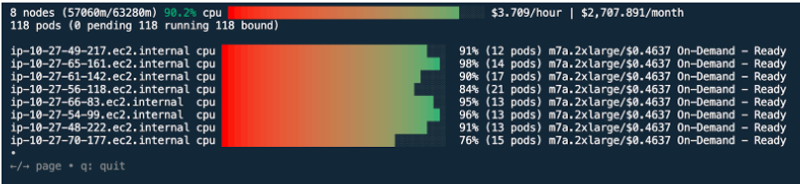
Our client came to us with a frustrating AWS EKS problem. Despite running Cluster Autoscaler, their monthly bill was a staggering $2,707 for EKS Nodes Only what should have been an optimized setup.
The culprit? Cluster Autoscaler's architectural limitations were forcing them into expensive compromises:
- Uniform instance types: All workloads crammed onto identical m7a.2xlarge instances
- Reactive scaling: Waiting for resource shortages before adding capacity
- Manual node group management: Separate ASGs required for different instance types
- Poor spot integration: Limited ability to leverage cost-saving spot instances
The result was a classic overprovisioning nightmare where compute-intensive applications wasted memory resources while memory-heavy workloads left CPU cores idle.
Why Cluster Autoscaler Falls Short
Before diving into our solution, let's understand why Cluster Autoscaler creates these problems:
1. Auto Scaling Group Dependencies
Cluster Autoscaler operates through ASGs, which lock you into predefined instance types. Want to mix C5, R5, and M5 instances? You need separate node groups for each, creating management overhead.
2. Reactive Scaling Model
CA only scales after pods are pending due to resource constraints. This reactive approach causes:
- Application delays during traffic spikes
- Resource contention before new nodes arrive
- Poor user experience during scaling events
3. Limited Spot Instance Intelligence
While CA supports spot instances, it lacks sophisticated fallback mechanisms. If spot capacity isn't available, workloads simply wait rather than intelligently switching to on-demand instances.
4. Inefficient Resource Matching
CA provisions based on node group configurations, not actual workload requirements. This leads to consistent over or under-provisioning scenarios.
Enter Karpenter: The Game-Changer
Karpenter fundamentally reimagines how EKS handles node provisioning by bypassing Auto Scaling Groups entirely. Instead, it provisions EC2 instances directly based on actual pod requirements.
Our Strategic Implementation
We designed four specialized NodePools to match workload characteristics:
1. Compute-Optimized Pool (C-Series)
- Target: CPU-intensive applications
- Instance Types: C6i, C6a, C5 families
- Strategy: Spot-first with on-demand fallback
- Result: 60-70% cost reduction for compute workloads
2. Memory-Optimized Pool (R-Series)
- Target: Memory-intensive applications
- Instance Types: R6i, R5, R5a families
- Strategy: Intelligent spot provisioning
- Result: 50-65% savings on memory-heavy workloads
3. General Purpose Pool (M-Series)
- Target: Balanced CPU/memory applications
- Instance Types: M6i, M5, M6a families
- Strategy: Spot-prioritized with smart fallback
- Result: 45-55% cost optimization
4. Critical Workload Pool
- Target: Mission-critical applications
- Strategy: On-demand instances only
- Result: Guaranteed availability with controlled costs
Karpenter's Key Advantages
Proactive Scaling: Karpenter provisions nodes in seconds, not minutes, by monitoring unschedulable pods in real-time.
Instance Flexibility: Choose from hundreds of instance types automatically based on workload requirements.
Native Spot Integration: Seamlessly handle spot interruptions with automatic on-demand fallback.
Cost Intelligence: Built-in algorithms select the most cost-effective instances for each workload.
The Transformation Results
The migration from Cluster Autoscaler to Karpenter delivered dramatic improvements:
| Metric | Before (CA) | After (Karpenter) | Improvement |
|---|---|---|---|
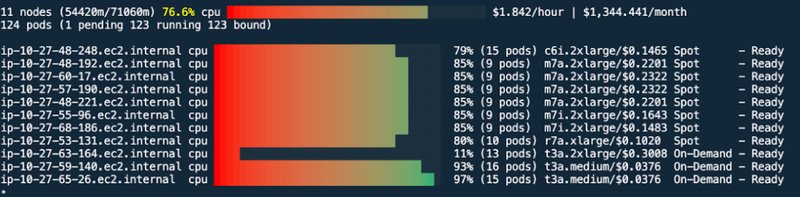
| Monthly Cost | $2,707.89 | $1,344.44 | 50.4% reduction |
| Hourly Rate | $3.71 | $1.84 | $1.87 savings/hour |
| Node Count | 8 uniform nodes | 11 optimized nodes | Right-sized capacity |
| Instance Types | 1 type (m7a.2xlarge) | 15+ optimized types | Workload matching |
| Resource Utilization | 65-75% | 85-95% | 20-30% improvement |
| Scaling Speed | 2-5 minutes | 15-45 seconds | 8x faster |
Annual Impact
- $16,356 in annual savings
- Improved application performance through right-sized resources
- Enhanced reliability with intelligent spot/on-demand balancing
- Reduced operational overhead with automated scaling
Technical Implementation Deep Dive
Before: The Cluster Autoscaler Limitation
- 8 nodes running identical m7a.2xlarge instances
- 90.2% CPU utilization but inconsistent memory usage
- Single point of failure for capacity planning
After: Karpenter Intelligence
- 11 nodes across multiple instance families
- 76.6% average utilization with better distribution
- Diversified infrastructure reducing single-point failures
Key Implementation Strategies
1. Workload Profiling
We analyzed application resource patterns to determine optimal instance families:
- CPU-bound applications → C-series instances
- Memory-intensive workloads → R-series instances
- Balanced applications → M-series instances
- Critical services → On-demand only
2. NodePool Configuration
Each NodePool includes:
- Resource requirements (CPU, memory, storage)
- Instance family preferences (C, R, M types)
- Availability zone distribution for fault tolerance
- Spot vs on-demand strategy based on workload criticality
3. Gradual Migration
- Phase 1: Deploy Karpenter alongside existing CA setup
- Phase 2: Migrate non-critical workloads to Karpenter NodePools
- Phase 3: Move critical applications with careful monitoring
- Phase 4: Decommission Cluster Autoscaler infrastructure
Lessons Learned & Best Practices
What Works
- Start with non-critical workloads for initial Karpenter deployment
- Use diverse instance types to maximize cost savings opportunities
- Implement proper resource requests/limits for optimal node sizing
- Monitor spot interruption patterns to fine-tune NodePool strategies
Common Pitfalls to Avoid
- Don't over-constrain NodePools - let Karpenter choose optimal instances
- Avoid mixing critical and non-critical workloads in the same NodePool
- Don't ignore resource requests - they're crucial for proper scaling
- Monitor costs continuously - optimization is an ongoing process
Why This Matters for Your EKS Strategy
For DevOps Teams
- Reduced operational overhead through automated node management
- Faster scaling response improving application performance
- Better resource utilization reducing waste and costs
For FinOps Teams
- Significant cost reduction through intelligent provisioning
- Improved cost predictability with usage-based scaling
- Better resource accountability through workload-specific node pools
For Engineering Teams
- Enhanced application performance through right-sized infrastructure
- Improved reliability with diversified instance types
- Reduced deployment complexity with automated scaling
Ready to Transform Your EKS Costs?
This case study demonstrates how strategic infrastructure optimization can deliver immediate financial impact while improving operational efficiency. The key is moving beyond traditional autoscaling approaches to intelligent, workload-aware provisioning.
Next Steps
- Audit your current EKS costs and instance utilization patterns
- Identify workload characteristics to design optimal NodePools
- Plan a phased Karpenter migration starting with non-critical applications
- Implement continuous monitoring to track cost and performance improvements
VirtueCloud's AWS experts specialize in these complex infrastructure transformations. Our FinOps methodology combines deep technical knowledge with cost optimization strategies to deliver measurable results.
Don't let outdated autoscaling drain your cloud budget. Contact VirtueCloud today to discover how much your organization could save with intelligent node provisioning.
VirtueCloud is an official AWS Partner specializing in cloud optimization, DevOps automation, and FinOps consulting. Our certified experts help enterprises maximize cloud ROI through strategic infrastructure design and intelligent cost management.
Also Read
Related articles you might find interesting
Ingress Got You This Far — A Field Guide to Gateway API & HTTPRoute
Why platform teams are re-routing north-south traffic through the Kubernetes Gateway API, what HTTPRoute changes on the ground, and how to migrate without a big-bang rewrite.
AWS Graviton: High-Performance Compute with Energy Efficiency and Cost Savings
Automated ECS Deployment: Fargate or EC2, Make it easy with VirtueCloud
Hassle-Free ECS: Terraform Automation + CI/CD Pipeline